August 2025 Question and Answer
Question #1
In the Red Sox-Angels game on June 23, 2025, it appeared that Angels’ third baseman Luis Rengifo had illegally blocked second base when tagging out Abraham Toro. Why wasn’t Rengifo called for obstruction in this play?
Answer
The Angels hosted the Red Sox on June 23rd. In the top of the fifth, the Red Sox had Jarren Duran on second base and no outs when Abraham Toro, facing Jack Kochanowicz, hit a ground ball to Zach Neto at shortstop. Neto threw to third baseman Luis Rengifo and Duran was caught in a pickle. He was subsequently tagged-out by second baseman Christian Moore. Toro attempted to reach second base where he was tagged-out by Rengifo who received the throw from Moore. It appeared the Rengifo had illegally blocked the base by setting up on the first base side of the base and dropping a knee without possession of the ball. Red Sox manager Alex Cora argued the no call with Crew Chief Alan Porter and was ejected.
It appeared that Cora had enough evidence to argue for the obstruction call. But acts of obstruction and interference should only be enforced in situations that affect the play. In the above play, in my opinion, and in the opinion of Porter and the umpiring crew, Toro would have been an easy out regardless of the actions of Rengifo. “We felt that the runner (Toro), no matter what the fielder (Rengifo) had done in that situation, the runner was out,” Porter told a pool reporter following the game. “He was out by a lot and that’s part of also not calling obstruction.” To call obstruction, the act must impede the progress of the runner. In the above play, Toro’s progress was not impeded. The no call was a good call. Also, credit the Angels for good base coverage in executing this double play. BTW-This was not the first time Porter ejected Cora over a obstruction situation at second base.
On Sept. 22, 2024, in a game against the Twins, Red Sox pitcher Nick Pivetta attempted to pick-off Byron Buxton at second base. Buxton was safe. Despite being called safe, Twins’ manager Rocco Baldelli argued that Boston second baseman Vaughn Grissom illegally blocked the base. The umpires huddled and agreed that Grissom had obstructed Buxton who was awarded third base.
Question #2
Answer
No. Both players had the right to be where they were. Chisholm did not deviate from his direct pathway to the plate to target Handley and Handley was reacting to the trajectory of the throw up the line.
Following are other situations where both the runner and the fielder have the “Right of Way,” and no violation should be called despite a collision. The batter bunts the ball in front of the plate and both the batter-runner and catcher collide. There’s a ground ball to the third baseman and his throw takes the first baseman wide of the base who collides with the batter-runner who is running legally in the Runner’s Lane. There is a runner attempting to steal second base and the catcher’s throw takes the fielder to the first base side of the base and both collide. The runner on third is attempting to steal home. The batter holds his position in the batter’s box and the catcher and batter collide as the catcher is attempting to tag the runner.
Question #3
In a minor league game earlier in the season, there was a play when two baseballs were in play confusing the outfielder. Can you explain what happened?
Answer
This is the play you are talking about.
The Iowa Cubs and the Indianapolis Indians met in a Triple A game at Victory Field on April 6th. In the top of the eighth inning, the Cubs had a runner on first when the batter hit safely to right field. At the same time the Indians’ right fielder was in the act of fielding the ball, a second baseball appeared in the vicinity of the confused right fielder who was obviously distracted. There were now two balls in play. The second ball came from the pitcher in the right field bullpen who threw a wild pitch that got by the catcher and ended-up near the Indianapolis right fielder. There was a play at the plate and the runner on first base scored. The batter ended up on second. The Cubs won the game, 4-1. Because this situation is not covered in the rules, rule 8.01 (c) allows the umpires to rule on any point not specifically covered in the rules. This situation (two balls in play) occurred more frequently in the older major league ballparks where the bullpens were located on the field along the outfield foul lines.
In the past, the two balls in play dilemma was treated the same as spectator interference except the umpires did not kill the play immediately. When the action stopped, the umpires would call “Time” and place the runners where they think they would be if only one ball (as usual) was in play. I believe current umpires should handle the play in the same fashion. The same enforcement philosophy should be used when beach balls and other objects are thrown on the field if it affects the play. If the umpires can kill the play before the pitch, they would do it, but of course that’s not always possible. In the above play, from information that I was provided, the umpires made no provision for the two balls in play and the run was allowed to score.
“The umpires didn’t call anything and let the play go,” said Indianapolis manager Chris Truby. “When I went out for an explanation, they said, ‘that is the risk of having the bullpen on the field.’ My main concern on the play was that my right fielder was obviously distracted and took a couple steps towards the ball that came from the bullpen. My argument was that the runner from first would not have scored had my right fielder not been distracted by the ball that came on the field.” Truby had a good argument
In my opinion, the umpires’ answer of having bullpens on the field is the “risk for such situations” is an unacceptable response. The umpires should have met and used common sense.
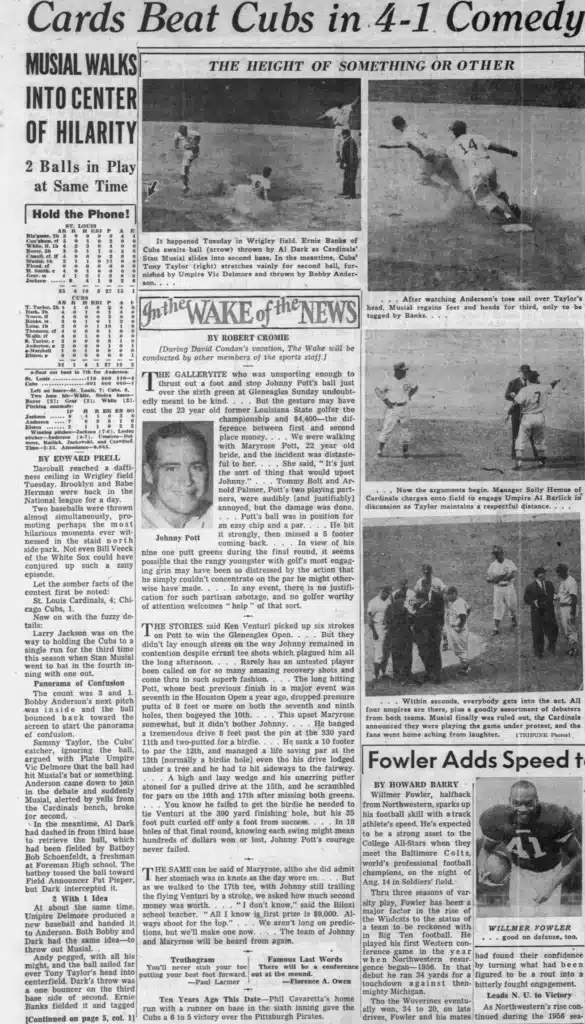
There was a classic play on June 30, 1959, in which there were two balls in play at the same time. It involved Hall of Famer Stan Musial in a game between the Cubs and Cardinals at Wrigley Field. It is one of the zaniest plays in baseball history (click on the pictures for more information).

Rich Marazzi
Rules consultant/analyst: Angels, Dodgers, Mets, Nationals, Orioles, Padres, Phillies, Pirates, Red Sox, Rangers, Royals, Tigers, Twins, White Sox, Yankees, YES, and Chicago Sports Network
